Raggie Jessy Rithaudeen
Back in 2014, PKR undertook to unseat Selangor’s then Menteri Besar, Tan Sri Abdul Khalid Ibrahim, via the unprecedented ‘Kajang Move’.
Six years later, Bersatu’s Tan Sri Muhyiddin Yassin colluded with UMNO and PAS to collapse the Pakatan Harapan government under Tun Dr Mahathir Mohamad, a manoeuvre that came to be known as the ‘Sheraton Move’.
In 2018, Datuk Seri Anwar Ibrahim architected the Port Dickson Move, engineered to return him to Parliament via a by-election as a prelude to the premiership.
Now, with Najib Razak’s house arrest bid rejected, and with his sentence confirmed at 165 years’ imprisonment (15-year terms running concurrently) attached with a RM11.4 billion fine—imposed over four abuse-of-power and 21 money-laundering charges linked to 1MDB—political recalibration has again become inevitable rather than speculative.
Enter the “Sawadikap Move”
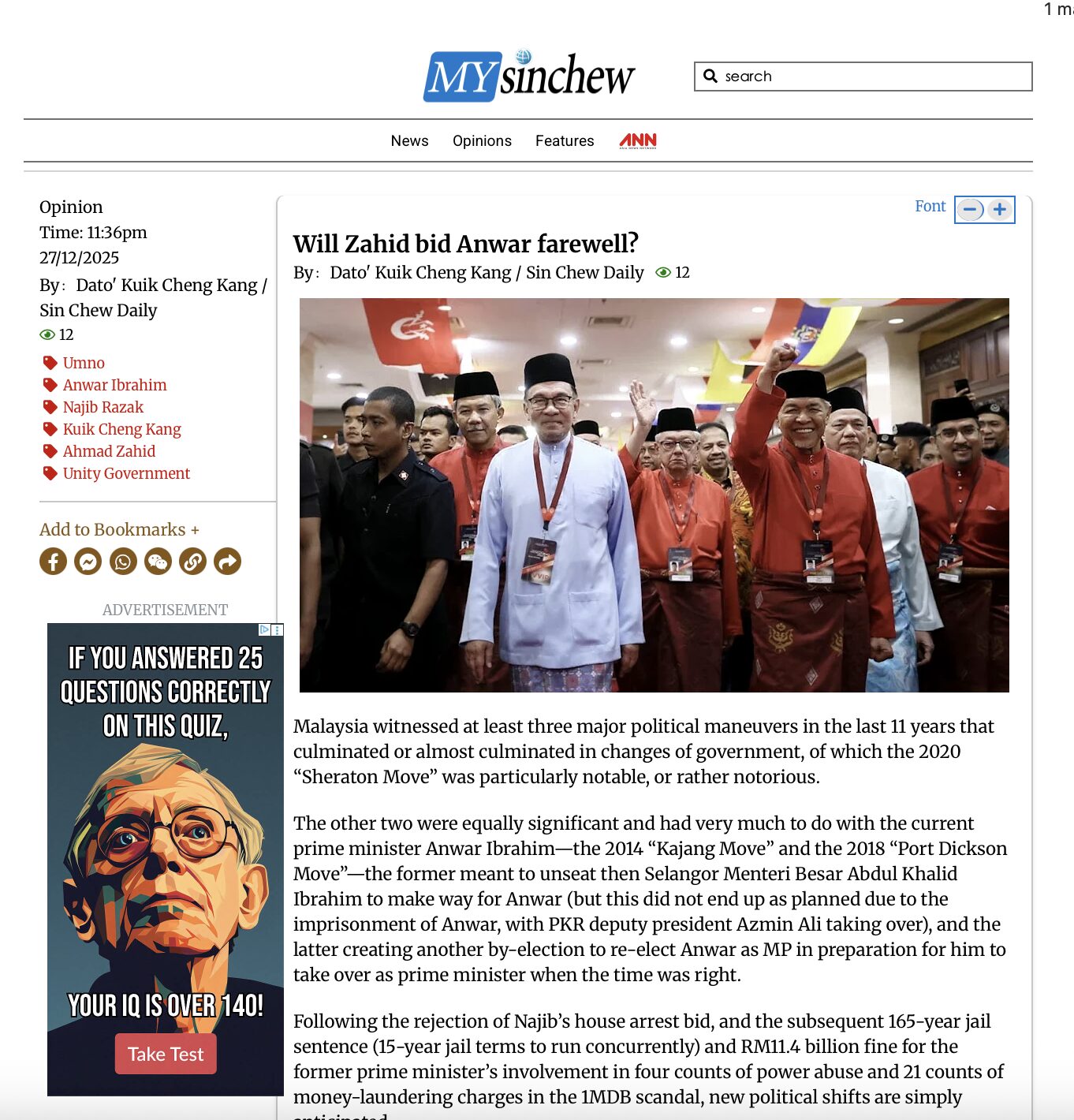
According to My Sinchew (link to article HERE, article screenshot below), a new sort of ‘move’ could be in the works.


Quoting an unnamed ‘reliable’ source, senior political figures from rival camps were said to have been spotted in Thailand roughly two weeks ago.
Their coincidental presence, according to the portal, has reignited talk of a discreetly choreographed realignment — now widely dubbed the “Sawadikap Move.”
It adds that such rumours are not new, given that Malaysian politics has previously entertained whispers of a “Dubai Move,” a “London Move,” and even an “Ismail Sabri Move,” each having fizzled out either because details leaked too early or because the supposed plots proved illusory.
Per My Sinchew, between now and the next parliamentary dissolution, several fault lines will shape whether this latest manoeuvre matures into something decisive:
1. PAS’ role remains the first unknown. Is the party preparing to capitalise politically? Have its leaders already met Umno figures, or even previously approached Anwar in exploratory talks?
2. Leadership dynamics within PAS matter. If Abdul Hadi Awang steps aside, would negotiations with rival blocs become materially easier?
3. Perikatan Nasional’s durability is also in question. Without PAS’ backing, how long can Muhyiddin Yassin realistically maintain control — both over PN and within Bersatu?
4. The Perlis episode, widely described as a political coup, could prove catalytic. Might it accelerate PN’s fragmentation and hasten the formation of a new Malay-centric alliance?
5. Hamzah Zainudin’s standing, particularly given PAS’ apparent endorsement, is another variable still being assessed behind closed doors.
6. The Unity Government’s longevity is increasingly uncertain. Can it realistically survive to the end of a full five-year term, or is early dissolution becoming unavoidable?
7. Ahmad Zahid Hamidi’s dilemma looms large. Facing rising internal dissent and the looming possibility that his Yayasan Akalbudi DNAA could be revived via judicial review, his strategic options are narrowing.
8. Sarawak Premier Abang Johari’s trajectory, often whispered about but rarely analysed openly, remains part of longer-term calculations.
9. The delayed disclosure of the former Yang di-Pertuan Agong Sultan Abdullah’s addendum order — revealed more than a year later — continues to raise unanswered questions.
10. Najib’s political future, finally, remains unresolved: parole, house arrest, or permanent political extinction.
Umno, DAP, and the Unity Government under strain
Here are some key points derived from the article:
In the days leading up to the High Court’s decision, many in Najib’s inner circle were confident he would be allowed to serve his sentence at home. The rejection of that bid therefore triggered predictable anger — anger that quickly found a political outlet.
DAP publicity secretary Yeo Bee Yin’s Facebook post describing the ruling as “a cause for celebration” became the immediate flashpoint.
The backlash from Umno veterans and grassroots leaders was swift and intense, pushing long-simmering “exit Unity Government” sentiment closer to the surface.
Party insiders now expect this issue to dominate Umno’s general assembly on January 14, with pressure mounting on leadership to reconsider its alliance with Pakatan Harapan. Whether Zahid yields or attempts to suppress the revolt will be decisive.
Opposition figures, including Tun Mahathir Mohamad, are already exploiting the moment, framing Umno as subservient to DAP — a narrative likely to further erode Malay support and deepen mistrust toward DAP within the Malay electorate.
At the same time, hostility cuts both ways. Chinese Malaysian distrust of Umno remains entrenched and is unlikely to dissipate quickly.
Signals, counter-signals, and strategic messaging
As tensions peaked, Zahid posted a Facebook image bearing the words “Jangan simbah minyak pada api marak”(“don’t pour oil on a raging fire”), an apparent attempt to calm tempers.
Yet on the same day, the Attorney General’s Chambers confirmed that a judicial review had been filed challenging Zahid’s September 2023 DNAA — a coincidence that raised eyebrows across the political spectrum.
These developments will shape Umno’s next move and, by extension, the Unity Government’s survival.
Claims that remarks by figures such as Yeo Bee Yin or Tony Pua were careless individual missteps miss the broader picture. The episode is widely seen as a DAP political manoeuvre aimed at reclaiming Chinese support after a bruising defeat in the recent Sabah election.
DAP recognises that its alliance with Umno — and with Zahid personally — cost the party its long-held moral high ground. Reasserting credibility may therefore require visible confrontation, even at the risk of destabilising the government.
High stakes for all sides
That strategy carries obvious risks: thinning support among conservative Malays and reinforcing perceptions that DAP lacks sensitivity toward Malay concerns and cultural norms.
Chinese voters, meanwhile, continue to judge DAP by familiar benchmarks — commitment to anti-corruption, social justice, lifestyle freedoms, and a business-friendly environment unburdened by spiralling costs. With 40 parliamentary seats, DAP remains indispensable to the Unity Government, and expectations remain high.
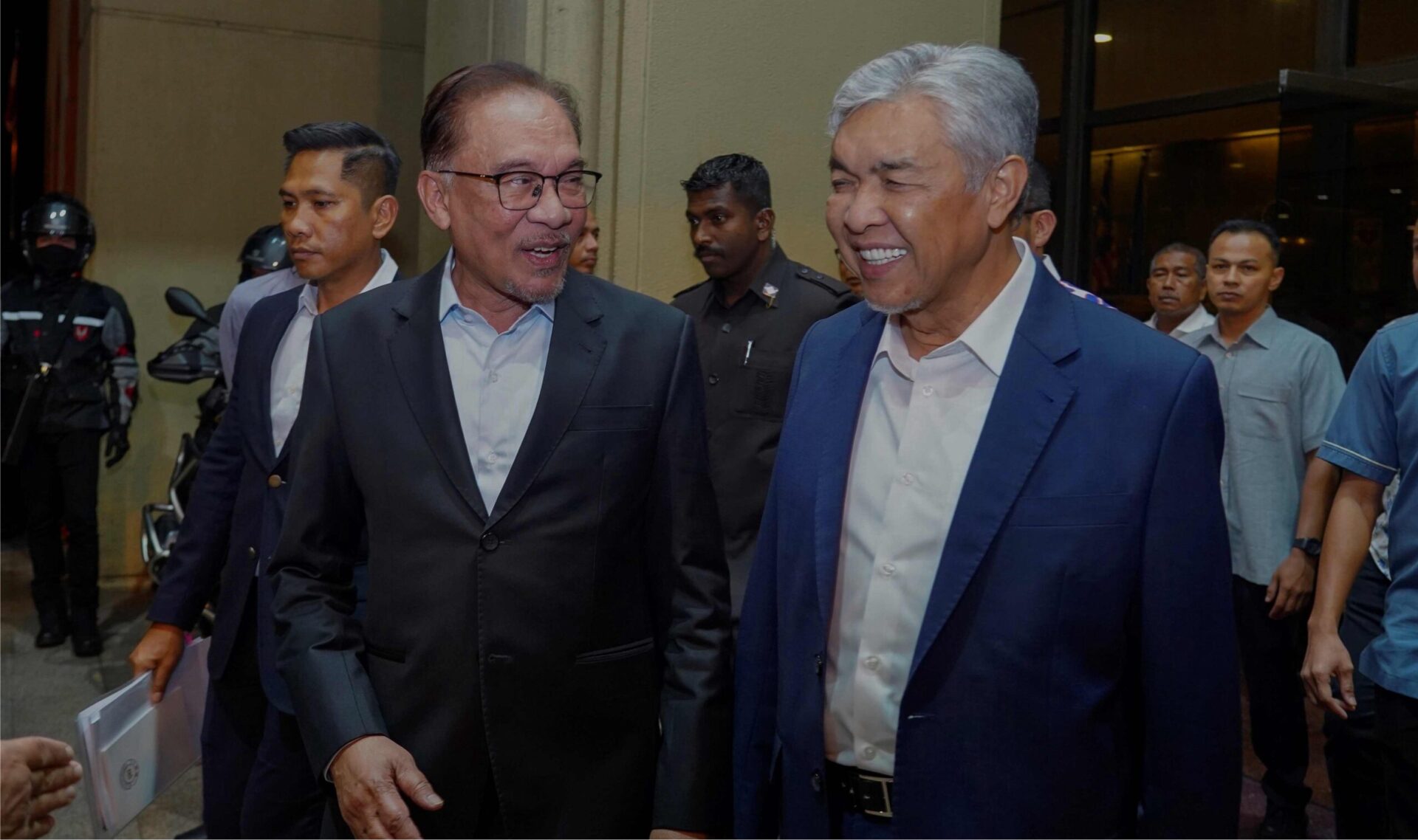
What is indisputable is that the current government would not exist without Ahmad Zahid. Legally, Najib’s conviction stands and punishment is unavoidable. Politically, however, the court ruling has destabilised the delicate equilibrium holding Umno, Zahid, and the Unity Government together.
The decisive question now is simple but consequential: Will Ahmad Zahid continue to shield the Unity Government — or will the Sawadikap Move, if it is real, mark the beginning of its end?
Cabinet resignations, party withdrawals, or an early election all remain plausible. Whether this drama culminates in a shock finale or dissolves into another non-event rests largely on one man — and how he chooses to write the next act.