
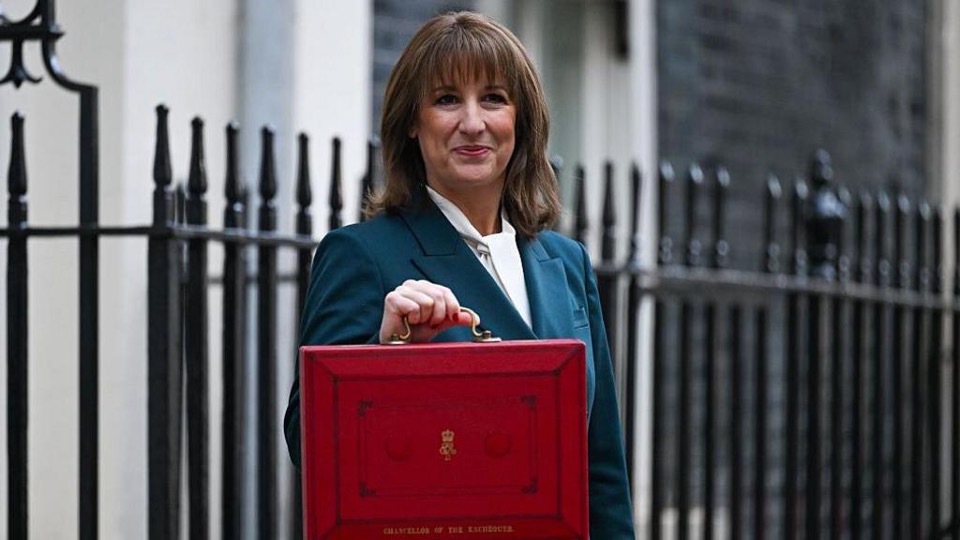
Chancellor Rachel Reeves is facing escalating political criticism after rejecting claims that she overstated the weakness of the public finances in the lead-up to last week’s Budget.
Speaking on the BBC, Reeves insisted she had not misled the public, despite fresh disclosures that the Office for Budget Responsibility (OBR) privately assessed the government’s finances as stronger than widely assumed weeks before the Budget was delivered.
Documents published after Wednesday’s fiscal statement revealed that the watchdog had told the Treasury in mid-September that it expected higher wages and a healthier fiscal position than previously forecast. Yet in the weeks that followed — including during a speech on 4 November — Reeves repeatedly warned that an expected downgrade to productivity projections had severely constrained government finances.
Appearing on BBC One’s Sunday with Laura Kuenssberg, the chancellor said she did not “accept” the accusation that she had painted an unduly bleak picture of the economy. When asked directly whether she could be trusted, Reeves replied that she could.

Chancellor Rachel Reeves is facing escalating political criticism after rejecting claims that she overstated the weakness of the public finances in the lead-up to last week’s Budget.
Speaking on the BBC, Reeves insisted she had not misled the public, despite fresh disclosures that the Office for Budget Responsibility (OBR) privately assessed the government’s finances as stronger than widely assumed weeks before the Budget was delivered.
Documents published after Wednesday’s fiscal statement revealed that the watchdog had told the Treasury in mid-September that it expected higher wages and a healthier fiscal position than previously forecast. Yet in the weeks that followed — including during a speech on 4 November — Reeves repeatedly warned that an expected downgrade to productivity projections had severely constrained government finances.
Appearing on BBC One’s Sunday with Laura Kuenssberg, the chancellor said she did not “accept” the accusation that she had painted an unduly bleak picture of the economy. When asked directly whether she could be trusted, Reeves replied that she could.
She maintained that her warnings were justified by what she characterised as a shrinking budgetary margin under the government’s fiscal rules, telling the programme that the OBR had indicated there had been “less fiscal space than there was” and that she had been “upfront” about her decision-making throughout.
Reeves said official modelling showed that the amount of headroom available to the government — the buffer between projected spending and borrowing limits — had fallen sharply from £9.9bn in the spring forecast to £4.2bn in the autumn.
“I didn’t have an extra £4bn to play with,” she said, arguing that the remaining margin had been too small to sustain a credible financial plan.
“I clearly could not deliver a budget with just £4.2bn of headroom,” she said, adding it would have been “the lowest surplus any chancellor ever delivered” and would inevitably have drawn criticism.
She said the objective of her fiscal package had been to strengthen the buffer against economic shocks, telling the programme: “I was clear that I wanted to build up that resilience and that is why I took those decisions to get that headroom up to £21.7bn.”
Reeves also rejected claims that the situation had been exaggerated to justify higher welfare spending. She said recent welfare policy changes — including reforms made in the previous six months and decisions on the Winter Fuel Allowance — had already created unavoidable funding pressures.
“I did say when those policies changed just before the summer that we would have to find that money in the Budget, so I was very upfront about that,” she said.
She confirmed that scrapping the two-child benefit limit had been a deliberate Budget choice, saying: “Yes, I did make the decision in the Budget to scrap the two-child [benefit] limit – that was funded by increases on online gambling taxes and also by cracking down on tax avoidance and tax evasion, fully costed and fully funded, and lifting half a million children out of poverty.”
On the issue of frozen income tax thresholds — a move criticised as a stealth tax rise — Reeves acknowledged the policy was not explicitly set out in Labour’s manifesto.
“I recognise I did not say that in the manifesto,” she said, adding that subsequent developments had altered the fiscal picture: “but since then we’ve had both a significant downgrade in the productivity forecast but also huge global turbulence.”
She warned that failure to maintain investor confidence would carry severe consequences.
“I have to respond to all those things because, if I were to lose control of the public finances, we would be punished,” she said.
“Punished by financial markets that hold £2.6tn of public debt, and punished with higher interest rates, which wouldn’t affect just the country but would also affect every single business that borrows, and every single family that has a mortgage.”
The controversy has escalated into a political showdown. Conservative leader Kemi Badenoch renewed her call for Reeves to resign, accusing her of using pessimistic forecasts to justify tax increases.
Appearing alongside Reeves on the BBC programme, Badenoch said she was “absolutely not” satisfied with the chancellor’s explanation.
“The chancellor called an emergency press conference telling everyone about how terrible the state of the finances were and now we have seen that the OBR was telling her the complete opposite,” she said.
“ She was raising taxes to pay for welfare – the only thing that was unfunded was the welfare payments that she has made, and she’s doing it on the backs of a lot of people out there who are working very hard and getting poorer – and because of that I believe she should resign.”
Badenoch said her party’s shadow chancellor, Mel Stride, had written to the Financial Conduct Authority requesting an investigation.
She alleged Reeves had attempted to condition markets in advance of the Budget by softening expectations, accusing her of efforts to “pitch-roll her budget – tell everyone how awful it would be and then they wouldn’t be as upset when she finally announced it”, which she said could amount to “market manipulation”.
Downing Street has rejected allegations that the chancellor misrepresented the state of the economy. Prime Minister Sir Keir Starmer is expected to publicly defend Reeves in a speech on Monday, with officials saying he will argue the Budget is designed to reduce inflation and ease pressure on household costs.
Adapted From: