
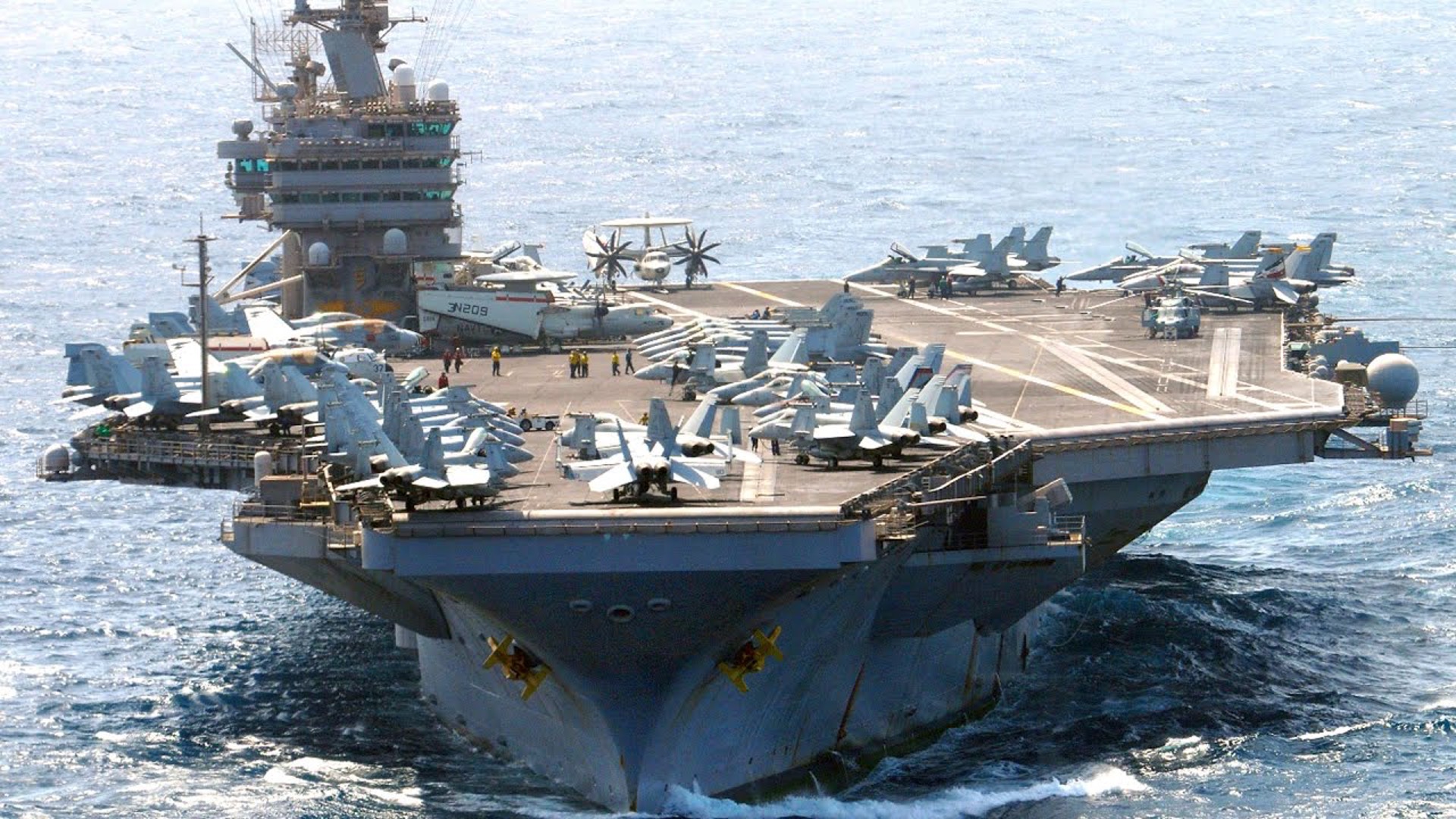
The United States is escalating its military posture in the Middle East as unrest in Iran continues to claim thousands of lives, with President Donald Trump confirming that a substantial U.S. naval force is moving toward the region amid heightened monitoring of Tehran.
Speaking to reporters aboard Air Force One after returning overnight from the World Economic Forum in Davos, Trump said the deployments were precautionary but unmistakable in scale.
“We have a lot of ships going that direction, just in case. I’d rather not see anything happen, but we’re watching them very closely … we have an armada … heading in that direction, and maybe we won’t have to use it.”
U.S. defense officials expect the aircraft carrier USS Abraham Lincoln and several guided-missile destroyers to arrive in the Middle East within days.

The United States is escalating its military posture in the Middle East as unrest in Iran continues to claim thousands of lives, with President Donald Trump confirming that a substantial U.S. naval force is moving toward the region amid heightened monitoring of Tehran.
Speaking to reporters aboard Air Force One after returning overnight from the World Economic Forum in Davos, Trump said the deployments were precautionary but unmistakable in scale.
“We have a lot of ships going that direction, just in case. I’d rather not see anything happen, but we’re watching them very closely … we have an armada … heading in that direction, and maybe we won’t have to use it.”
U.S. defense officials expect the aircraft carrier USS Abraham Lincoln and several guided-missile destroyers to arrive in the Middle East within days.
Additional air defense assets are also being positioned, primarily around U.S. and Israeli airbases. The United Kingdom confirmed it will deploy RAF Eurofighter Typhoon jets from No. 12 Squadron to Qatar, following a request from Doha.
The show of force comes as activists report a sharp rise in casualties stemming from Iran’s crackdown on nationwide protests.
The U.S.-based Human Rights Activists News Agency (HRANA) said Friday that at least 5,002 people have been killed since unrest erupted late last month.
The group said the total includes 4,716 demonstrators, 203 individuals affiliated with the government, 43 children, and 40 civilians not directly participating in protests. HRANA also reported that at least 26,541 people have been arrested.
HRANA’s figures are drawn from a network of activists operating inside Iran and have been considered reliable during previous periods of unrest.
The demonstrations began on 28 December after a sudden drop in the value of the rial prompted traders in Tehran to protest.
The movement quickly spread nationwide, evolving into calls for the overthrow of the government and marking the most severe and lethal unrest Iran has experienced since the 1979 revolution.
Addressing an emergency session of the United Nations Human Rights Council in Geneva, UN High Commissioner for Human Rights Volker Türk described widespread killings in public spaces and residential neighborhoods.
He said video evidence showed “hundreds in morgues with fatal injuries to their heads and chests,” while also noting that hundreds of security personnel had been killed.
Türk urged Iranian authorities to “end their brutal repression,” including the use of summary trials, and called for a complete halt to executions.
He said recent remarks by Iran’s judiciary chief—who warned of no leniency for detainees—were a “chilling development.”
“I am deeply concerned by contradictory statements from the Iranian authorities about whether those detained in connection with the protests may be executed,” Türk said, adding that Iran “remains among the top executioner states in the world,” with at least 1,500 executions reported last year.
Iranian officials have attempted to discredit the protests by claiming that violent actors infiltrated otherwise peaceful demonstrations. Türk rejected that justification.
“None of this would justify resorting to disproportionate use of force or coercing families,” he said, citing at least 100 forced confessions and a lack of transparency in legal proceedings.
Those detained, he said, include lawyers, human rights activists, café owners, athletes and actors.
Türk also said Iran imposed the longest internet shutdown ever recorded in the country, severely restricting communication and leaving families unable to verify the safety of relatives.
Mai Sato, the UN special rapporteur on human rights in Iran, called for access to the country to conduct a full investigation.
“The Iranian people have shown enormous courage by talking truth to power,” she said, urging the international community to respond accordingly.
She added: “Lethal force can only be used as a last resort to protect life and must be lawful, necessary and proportionate. I’ve received countless videos showing security forces using lethal force against unarmed protesters.”
While the protest movement has largely subsided under the weight of the crackdown, chants of “death to the dictator” continue to be heard at funerals, many of which remain heavily attended.
Videos continue to surface showing security forces using live fire against protesters, particularly between 5 and 8 January.
Media restrictions have tightened further. One of Iran’s leading reformist newspapers, Ham-Mihan, was shut down after publishing reports on the pursuit of protesters inside a hospital and on the broader severity of the crackdown.
Many prominent reformist figures have remained silent, while those allowed limited exposure have blamed both government actions and social fragmentation following the currency collapse.
In his most extensive remarks to date on the violence, Iranian President Masoud Pezeshkian—elected 18 months ago as a reformist—said that “the civil and just protest of the people was turned into a bloody and violent battle due to a conspiracy by those who wish Iran ill will.”
From Washington, U.S. Treasury Secretary Scott Bessent attributed the unrest to the impact of American sanctions, saying in Davos that economic pressure had precipitated the crisis.
“We saw a major bank go under. The central bank has started to print money. There is a dollar shortage. They are not able to get imports, and this is why the people took to the streets,” he said, calling the strategy “economic statecraft, no shots fired.”
Trump has continued to leave open the possibility of further military action against Iran following Washington’s involvement alongside Israel in a 12-day conflict in June targeting Iran’s nuclear and ballistic missile programs.
In recent days, however, officials on both sides have signaled an interest in allowing diplomacy to proceed.
Iran has issued its own warning. Ali Abdollahi Aliabadi, head of Iran’s Khatam-al Anbiya Central Headquarters, said Thursday that any U.S. military strike would render all American bases in the region “legitimate targets.”
THE THIRD FORCE
