
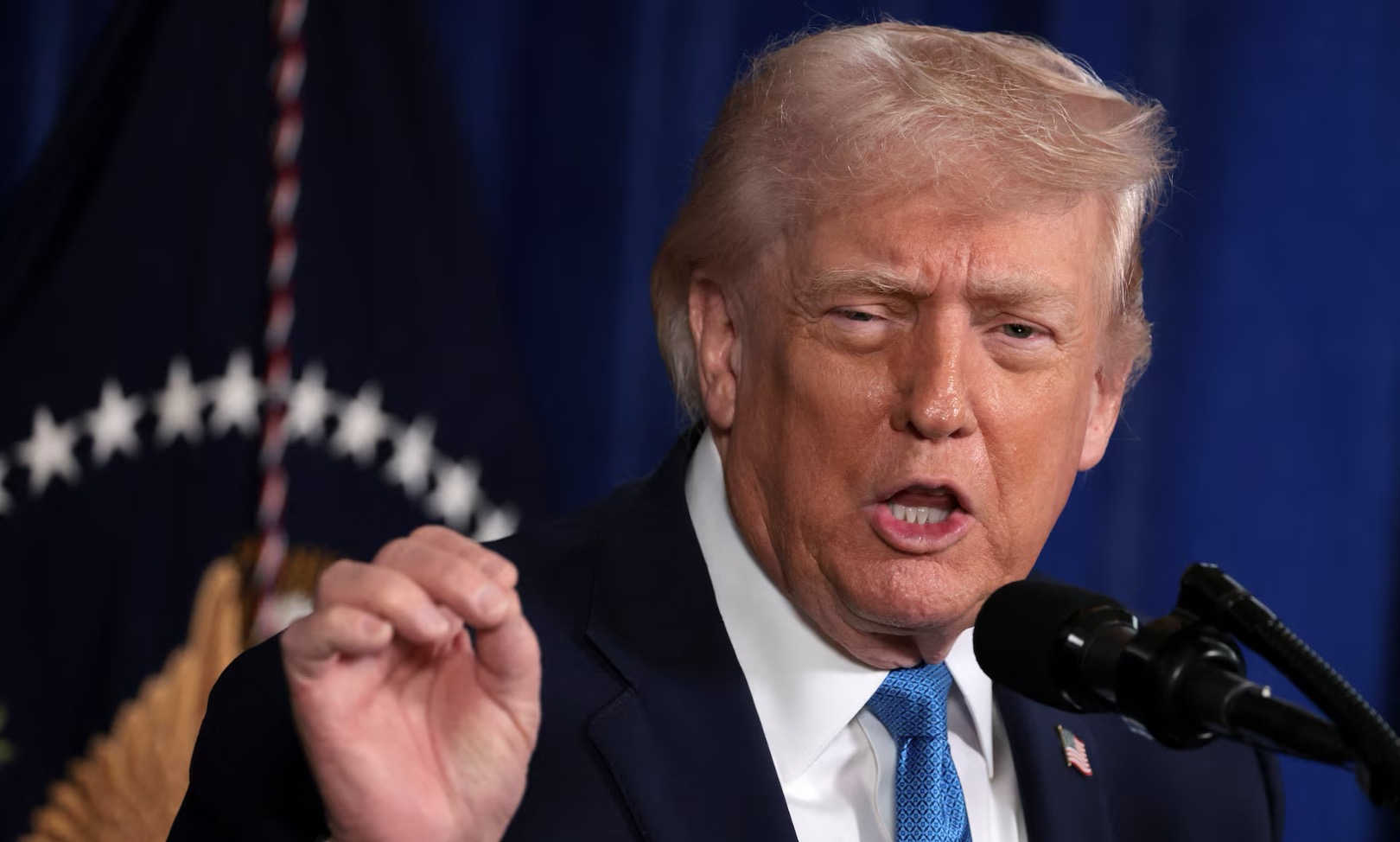
U.S. President Donald Trump has indicated that American involvement in Venezuela could extend years beyond the immediate aftermath of last weekend’s military operation that resulted in the capture of Venezuelan leader Nicolás Maduro.
In an interview with The New York Times, Trump said that “only time will tell” how long his administration would continue to “oversee” Venezuela following Saturday’s raid.
Per BBC, he declined to specify whether elections would be held to replace the interim government now headed by Delcy Rodríguez, a longtime Maduro ally designated by Venezuela’s Supreme Court.
Trump’s comments came as his administration signaled that U.S. control over Venezuela’s oil sector would not be temporary.

U.S. President Donald Trump has indicated that American involvement in Venezuela could extend years beyond the immediate aftermath of last weekend’s military operation that resulted in the capture of Venezuelan leader Nicolás Maduro.
In an interview with The New York Times, Trump said that “only time will tell” how long his administration would continue to “oversee” Venezuela following Saturday’s raid.
Per BBC, he declined to specify whether elections would be held to replace the interim government now headed by Delcy Rodríguez, a longtime Maduro ally designated by Venezuela’s Supreme Court.
Trump’s comments came as his administration signaled that U.S. control over Venezuela’s oil sector would not be temporary.
Earlier Wednesday, the White House said the United States would regulate sales of sanctioned Venezuelan oil “indefinitely.” Energy Secretary Chris Wright said maintaining control over oil exports was necessary to exert leverage over authorities in Caracas.

Trump acknowledged that reviving Venezuela’s oil industry would not be immediate, saying it would “take a while” to restore production in the country, which holds the world’s largest proven oil reserves.
He said the United States would be “taking oil” as part of its involvement, while also asserting that Venezuela would receive financial benefits from the arrangement.
The country’s oil output has fallen sharply in recent years due to mismanagement under Maduro and his predecessor, compounded by long-standing U.S. sanctions.
Trump told the New York Times that Secretary of State Marco Rubio was “in constant communication” with Rodríguez, adding that she is “giving us everything that we feel is necessary.”
He has previously said that the interim authorities agreed to use oil proceeds exclusively to purchase U.S.-made goods.
The president did not respond when questioned by Times reporters about his decision to recognize Rodríguez as Venezuela’s interim leader.
The political direction taken by Washington has diverged from expectations among Venezuela analysts, many of whom anticipated that Maduro’s removal would quickly pave the way for the return of opposition figures Edmundo González and María Corina Machado.
Trump addressed that prospect dismissively during his first press conference after the raid, questioning Machado’s political standing.
“I think it would be very tough for her to be the leader,” he said, alleging that she lacked sufficient “respect” and support inside Venezuela.
Machado had unified much of the opposition ahead of the 2024 presidential election but was barred from running by institutions aligned with the Maduro government.
She later backed González, a former diplomat, as her proxy candidate. While the electoral council declared Maduro re-elected, opposition vote tallies—later independently verified—indicated that González won by a wide margin.
Following the election, González fled into exile amid a government crackdown, while Machado went into hiding inside Venezuela.
In December, she undertook a covert journey across land, sea, and air to reach Oslo, where she received a Nobel Peace Prize for her “tireless work promoting democratic rights” in Venezuela. Her current location is unknown, though she has said she intends to return.
In an interview with opposition outlet La Patilla, Machado said Maduro’s removal had triggered an “irreversible process” leading Venezuela toward freedom. She expressed hope that the next phase of the transition would be “as short and swift as possible.”
She described the interim authorities as “the same regime it was under Maduro,” saying it was “being given instructions to dismantle itself.”
Machado reaffirmed that González was the legitimate president-elect and called for his mandate to be respected, emphasizing that “the first thing” required was the release of political prisoners.
More than 800 political detainees remain held in Venezuelan prisons, a situation that has drawn growing international attention. On Wednesday, Republican Rep. María Elvira Salazar posted repeatedly on social media demanding their release “immediately.”
Trump, however, appeared less focused on transitional governance details during his New York Times interview. According to the reporters, he “appeared far more focused on the rescue mission than the details of how to navigate Venezuela’s future.”
Asked directly about U.S. plans for the country, Trump said, “we will rebuild it in a very profitable way.” He added: “We’re going to be using oil, and we’re going to be taking oil.
“We’re getting oil prices down, and we’re going to be giving money to Venezuela, which they desperately need.”
The president is expected to meet representatives from three major U.S. oil companies at the White House on Friday to further discuss those plans.
Meanwhile, resistance to the administration’s approach surfaced on Capitol Hill. On Thursday, the U.S. Senate voted 52–47 to advance a resolution aimed at preventing further U.S. military action in Venezuela.
The measure invokes the War Powers Act and clears the way for debate, though a subsequent vote would be required for passage.
The vote marks the first instance during Trump’s second term in which the Senate has moved to limit his use of military authority.
Even if approved by both chambers, the resolution would remain subject to a presidential veto, making its practical impact uncertain.
THE THIRD FORCE
